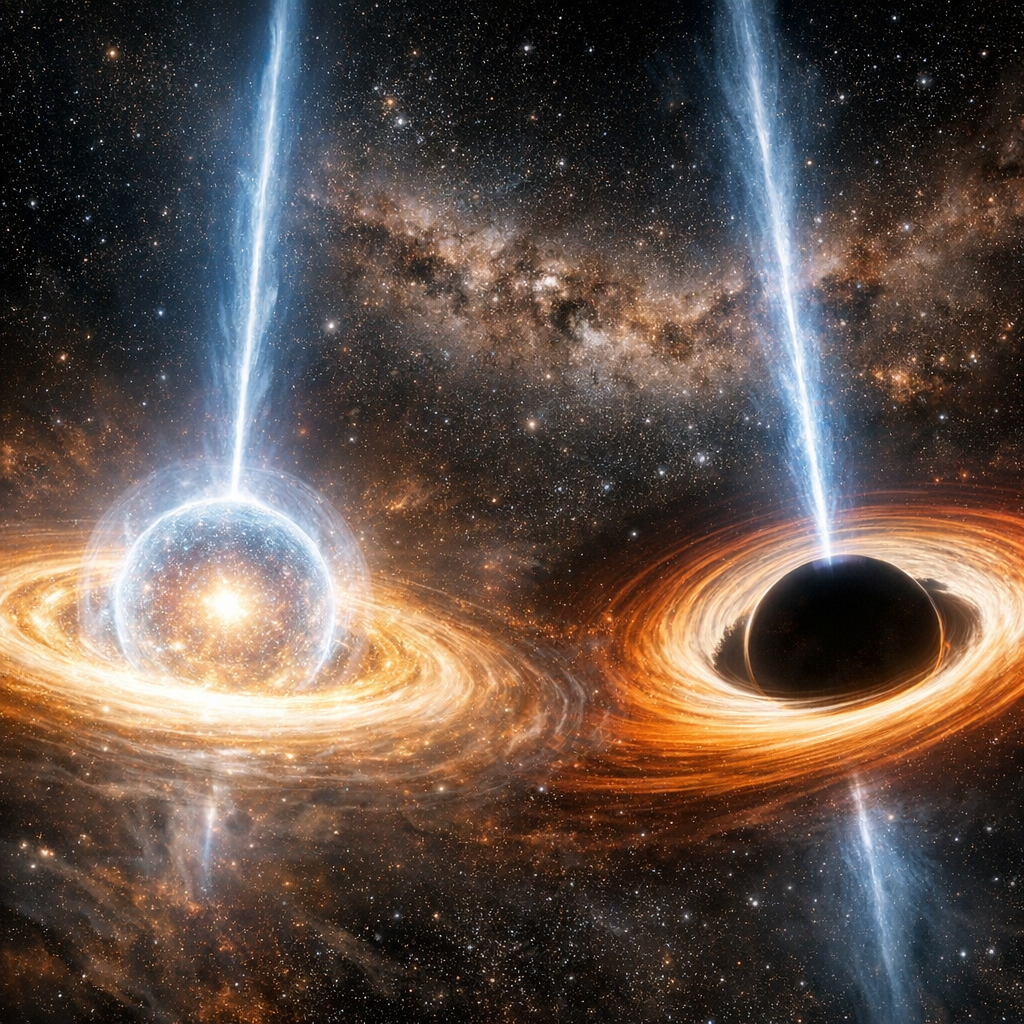
A recent article published by Innovation News Network, titled “Gravastar theory offers alternative to black holes,” revisits a provocative idea that challenges one of modern astrophysics’ most widely accepted concepts. Rather than viewing black holes as regions of spacetime defined by singularities and event horizons, the gravastar model proposes a fundamentally different structure that could reshape how scientists interpret extreme cosmic objects.
The gravastar, short for “gravitational vacuum star,” was first theorized as a hypothetical alternative to black holes, with early work described in studies such as Mazur and Mottola’s gravastar model. It suggests that what appears to be a black hole could instead be an object with no singularity at its core. In this model, the collapse of a massive star does not result in an infinitely dense point. Instead, it forms a core of exotic dark energy surrounded by a thin shell of ultra-dense matter. This configuration prevents the formation of a traditional event horizon while still producing gravitational effects that closely resemble those attributed to black holes.
The Innovation News Network article highlights the growing interest in whether observational data might eventually distinguish between these two possibilities. Black holes have long been supported by indirect evidence, such as gravitational wave detections and imaging from the Event Horizon Telescope. However, the gravastar model raises the possibility that these observations could be interpreted in more than one way, especially given the extreme conditions involved and the limits of current measurement techniques.
One of the key motivations behind the gravastar concept is the effort to reconcile general relativity with quantum theory. Traditional black hole models lead to singularities, where known laws of physics break down. Gravastars, by contrast, avoid these infinities, potentially offering a more consistent framework that aligns with quantum principles. The idea also touches on the enduring puzzle of what happens to information that falls into a black hole, a question that has divided physicists for decades.
Despite its appeal, the gravastar theory remains speculative and faces significant challenges. Researchers must demonstrate not only that such objects could form under realistic astrophysical conditions, but also that they can be empirically distinguished from black holes. Subtle differences in gravitational wave signatures or electromagnetic emissions could provide clues, but current instruments may not yet be sensitive enough to make definitive distinctions.
The renewed focus on alternatives like gravastars reflects a broader trend in astrophysics toward questioning foundational assumptions as observational capabilities improve. As next-generation telescopes and detectors come online, scientists expect to gather more precise data about the behavior of matter and gravity in extreme environments.
For now, black holes remain the dominant explanation for the compact, massive objects observed across the universe. However, as the Innovation News Network article makes clear, the exploration of alternatives such as gravastars continues to play an important role in testing the limits of current theories and expanding the scope of scientific inquiry.