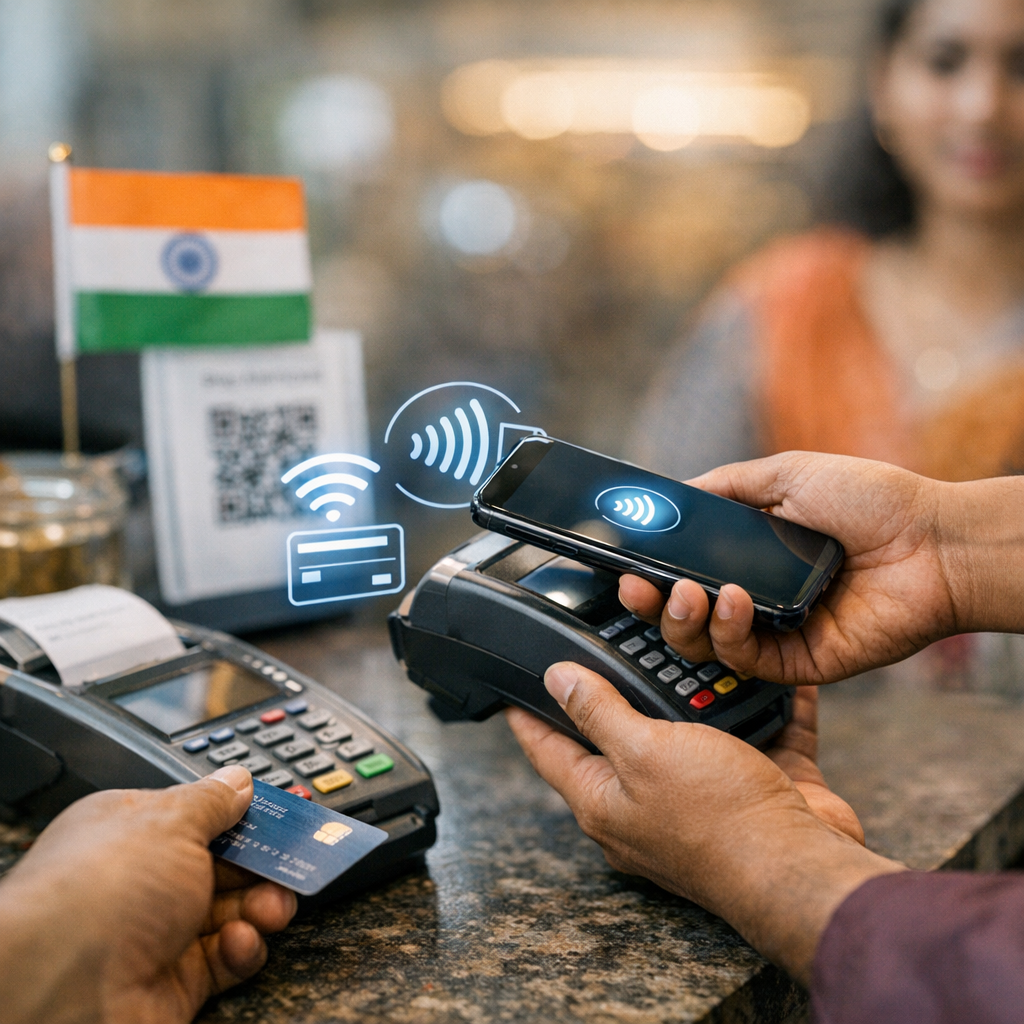
The steady shift toward contactless payments in India is reshaping how consumers transact, reflecting a broader transformation in the country’s digital payments ecosystem. A recent report by The Economic Times, titled “Contactless on the rise as Indian shoppers swipe less, tap more,” highlights how tap-to-pay methods are gaining momentum across urban and semi-urban markets, driven by convenience, speed, and growing acceptance infrastructure.
According to the report, the use of near-field communication (NFC)-enabled cards and devices has accelerated over the past year, with both banks and fintech companies pushing adoption through upgraded terminals and incentives. The familiar act of inserting or swiping a card is gradually being replaced by a tap, a shift that aligns with consumer expectations shaped by mobile-first payment systems such as the Unified Payments Interface (UPI).
Industry data cited in the Economic Times article suggests that contactless transactions have grown at a faster pace than overall card usage. This growth is being fueled in part by regulatory encouragement from the Reserve Bank of India, which has increased transaction limits for contactless payments and promoted digital payment adoption as part of its broader financial inclusion agenda.
Banks and payment networks are also playing a central role. Many have expanded issuance of NFC-enabled debit and credit cards as a default, while merchants have upgraded point-of-sale (POS) infrastructure to support tap-based transactions. This expansion is particularly visible in high-frequency retail environments such as supermarkets, quick-service restaurants, and transit systems, where speed and efficiency are critical.
Security concerns, once a barrier to adoption, appear to be diminishing as tokenization and enhanced authentication protocols become more widely implemented. Consumers are increasingly comfortable with the perceived safety of contactless systems, especially for low-value transactions where PIN entry is not required. At the same time, the integration of contactless capability into smartphones and wearable devices is further broadening usage scenarios.
The Economic Times report notes that while metropolitan areas lead adoption, smaller cities are beginning to catch up as digital infrastructure improves. Payment companies see significant headroom for growth in these regions, particularly as awareness campaigns and merchant onboarding initiatives expand.
Despite this progress, challenges remain. Acceptance infrastructure, though improving, is still uneven in parts of the country, and awareness among certain demographics remains limited. Additionally, the dominance of UPI, which relies on QR codes rather than NFC, creates a unique dynamic in India’s payments landscape. Contactless cards and devices must carve out a distinct space alongside an already highly successful digital payment system.
Even so, the direction of travel is clear. As highlighted in “Contactless on the rise as Indian shoppers swipe less, tap more” by The Economic Times, the convergence of policy support, technological capability, and consumer preference is accelerating the move toward faster, frictionless payments. The outcome is likely to be a more diverse payment ecosystem in which tapping, scanning, and other low-touch methods coexist, redefining everyday transactions across the country.