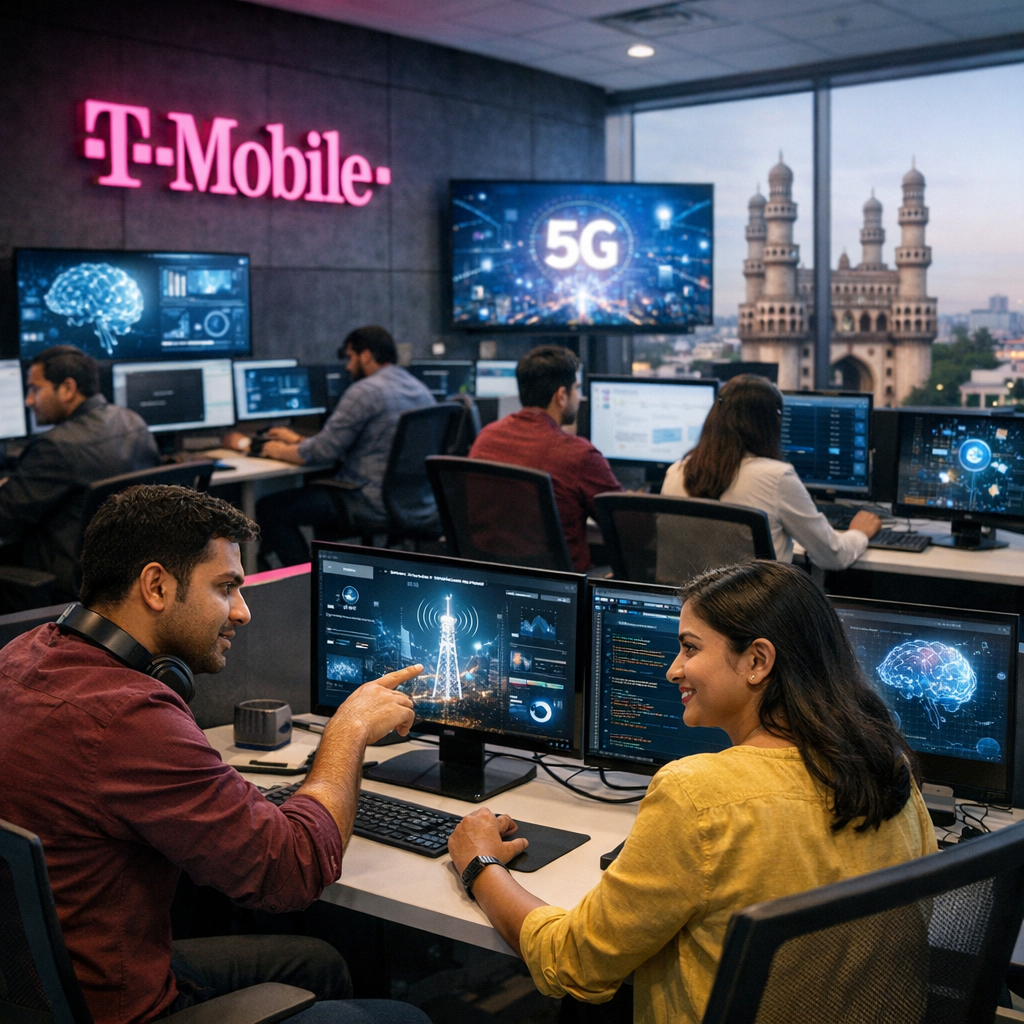
T-Mobile is expanding its global technology footprint with the launch of a new engineering centre in India, signalling a deeper commitment by the US telecommunications company to tap into the country’s growing pool of digital talent. The move, first reported by The Economic Times in its article “T-Mobile opens India tech centre to hire nearly 1,000 by 2027,” underscores a broader trend of multinational firms strengthening their presence in India to accelerate product development and innovation.
The new facility, located in Hyderabad, is expected to serve as a key hub for T-Mobile’s software engineering, network technology, and digital platform initiatives. The company plans to recruit close to 1,000 professionals over the next three years, focusing on roles spanning cloud computing, artificial intelligence, data analytics, and network automation.
Executives indicated that the expansion aligns with T-Mobile’s long-term strategy to enhance its technological capabilities while optimizing global operations. By establishing a dedicated centre in India, the company aims to benefit from both cost efficiencies and access to a highly skilled workforce that has become increasingly central to global technology development.
Industry analysts view the move as part of a continuing shift by telecom and technology firms toward distributed innovation models, where core research and engineering functions are spread across multiple geographies. India, in particular, has emerged as a preferred destination due to its large base of engineers and its established ecosystem of global capability centres operated by multinational corporations.
The Hyderabad centre will work closely with T-Mobile’s teams in the United States and other markets, contributing to areas such as 5G network evolution, customer experience platforms, and digital infrastructure. The company is expected to leverage the new hub to accelerate product rollouts and improve service reliability through advanced analytics and automation.
The expansion also comes amid intensifying competition within the global telecom sector, where operators are investing heavily in next-generation technologies to differentiate their offerings. Strengthening in-house engineering capabilities has become a priority as companies seek to reduce reliance on external vendors and maintain greater control over innovation pipelines.
India’s growing importance in global technology strategy is further underscored by the increasing presence of major telecom players establishing engineering and research bases in the country. T-Mobile’s decision to scale operations there reflects both the maturity of the local talent market and the strategic value of integrating India more deeply into global product development cycles.
As hiring ramps up through 2027, the success of the Hyderabad centre will likely be measured by its ability to deliver high-impact innovations while integrating seamlessly with T-Mobile’s broader technological ecosystem. The initiative represents not only an investment in talent, but also a bet on India’s role as a central node in the future of telecommunications innovation.