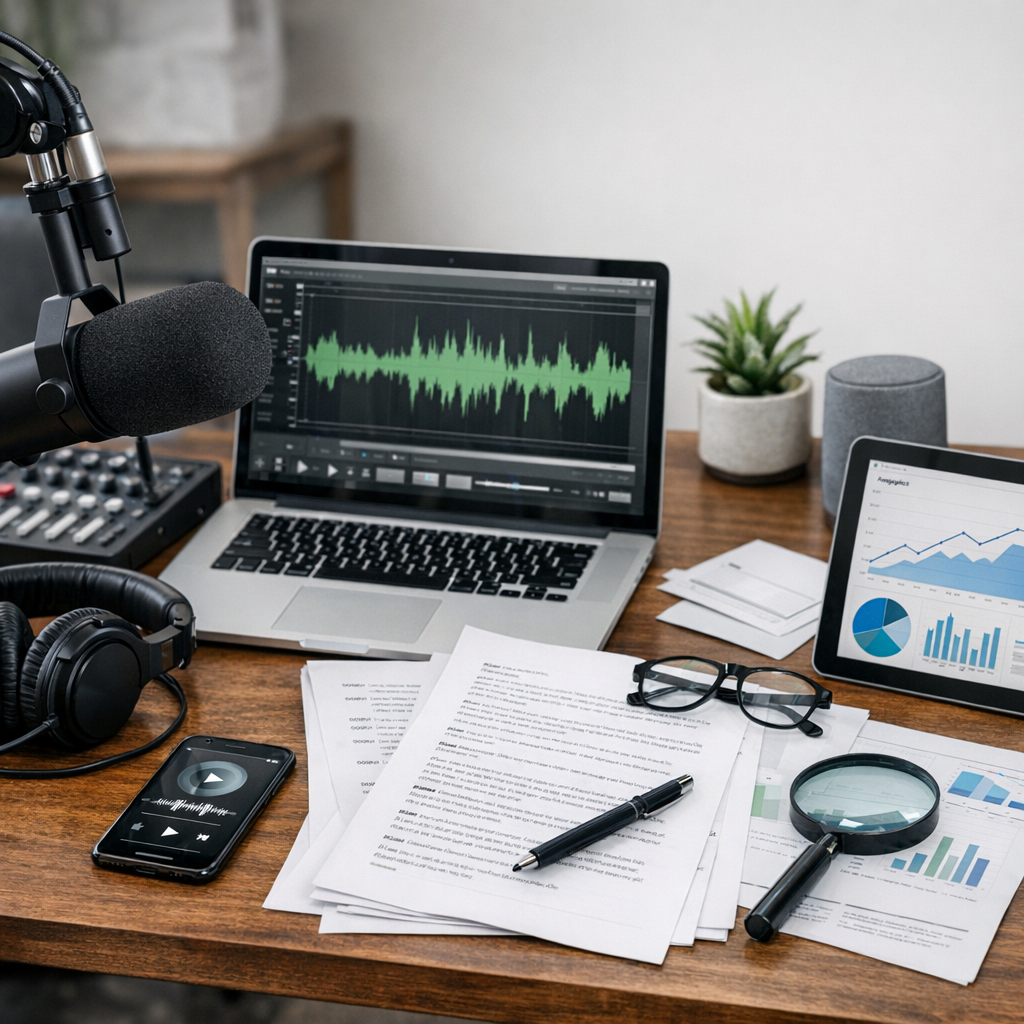
A recent article published by Developer Tech, titled “How audio transcripts help podcasts reach more listeners,” highlights a growing shift in how podcasters expand their audiences and improve accessibility in an increasingly competitive digital media landscape. As podcasts continue to proliferate, creators are turning to transcripts not merely as supplementary materials but as strategic tools for discovery, inclusion, and engagement.
The Developer Tech report underscores that transcripts serve a dual purpose: they make audio content accessible to people with hearing impairments while simultaneously enhancing search engine visibility. By converting spoken words into indexable text, podcasts become more discoverable through traditional search queries, allowing episodes to surface in ways that audio alone cannot achieve. This is particularly significant as search engines still rely heavily on text-based indexing to rank and retrieve content.
The article points out that transcripts can broaden a podcast’s reach beyond its core listenership. Readers who prefer skimming content, or who want to extract specific information quickly, are more likely to engage with a transcript than an entire audio episode. This flexibility caters to diverse consumption habits, especially in professional or educational contexts where time constraints often limit the feasibility of listening to full recordings.
Developer Tech also notes that transcripts can improve user engagement and retention. By offering a written counterpart, podcasters enable users to revisit key points, quote sections accurately, and share excerpts more easily across platforms. This amplifies the podcast’s presence on social media and in written discourse, further extending its influence.
Another key advantage identified in the article is the role transcripts play in supporting multilingual accessibility. Once content exists in text form, it can be translated more efficiently, opening the door to international audiences. This is particularly relevant as podcasting becomes a global medium, with creators seeking to reach listeners across linguistic and cultural boundaries.
However, the article also acknowledges challenges associated with transcription. Automated tools, while increasingly sophisticated, can still struggle with accents, technical terminology, and poor audio quality. As a result, achieving high accuracy often requires human oversight or editing, which can introduce additional costs and time commitments for content creators.
Despite these hurdles, the overall trend is clear. As Developer Tech reports, transcripts are evolving from optional add-ons into essential components of podcast production and distribution strategies. In a crowded market where visibility and accessibility are critical, the ability to repurpose audio into searchable, shareable text offers a distinct competitive advantage.
The article concludes that as tools for speech-to-text conversion continue to improve, the integration of transcripts will likely become standard practice. For podcasters seeking to grow their audiences and enhance inclusivity, the written word remains a powerful complement to the spoken one.