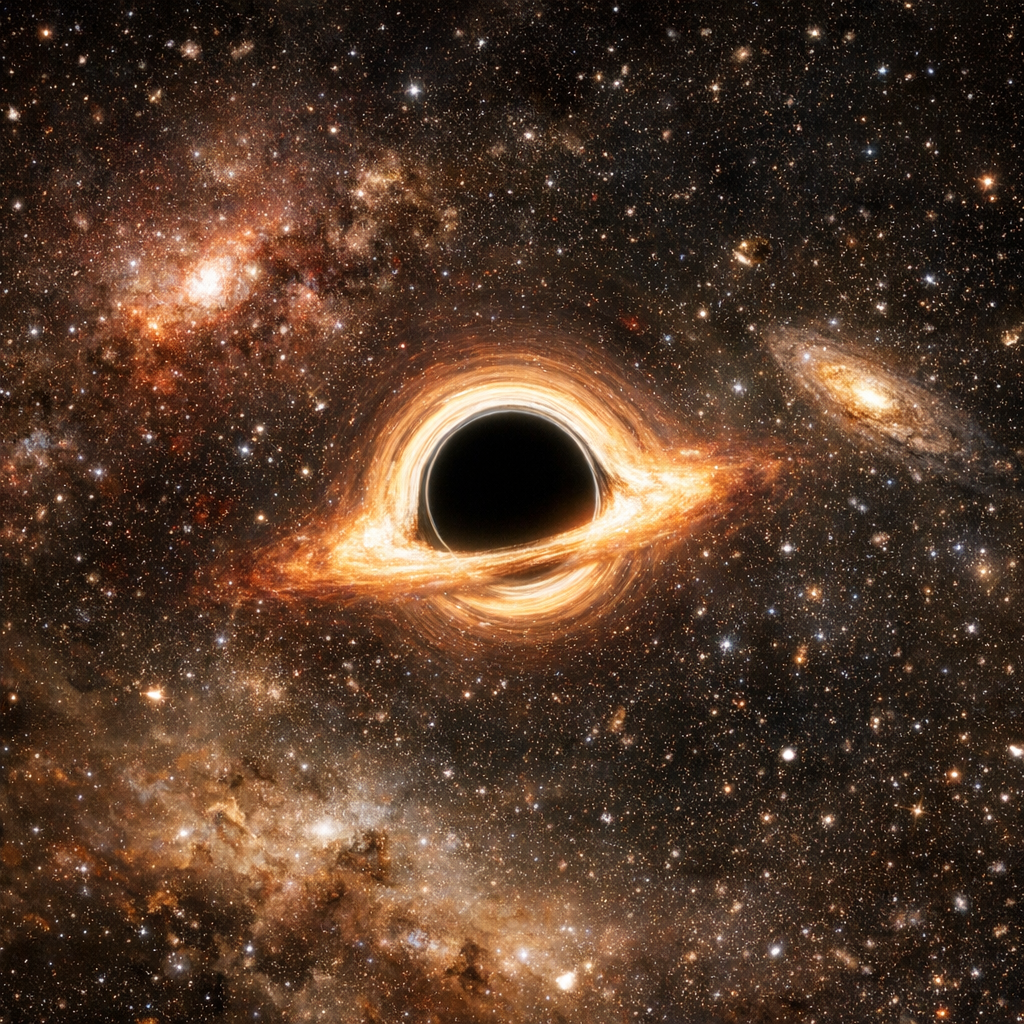
Astronomers have, for the first time, measured the mass of a dormant black hole dating back to the early universe, using observations from the James Webb Space Telescope (JWST). The finding, reported in the Innovation News Network article “Dormant black hole from early universe weighed for first time using JWST,” offers a rare glimpse into the growth and evolution of supermassive black holes during a formative period of cosmic history.
The study focused on a galaxy observed as it existed less than a billion years after the Big Bang. Unlike the actively feeding quasars that typically reveal themselves through intense radiation, this black hole appears largely inactive, making it significantly harder to detect and characterize. Researchers were nevertheless able to infer its presence and measure its mass by analyzing the motion of surrounding stars and gas, a method that relies on JWST’s unprecedented sensitivity in the infrared.
By capturing fine details in the galaxy’s light spectrum, the team identified signatures of stellar motion influenced by a massive central object. These measurements allowed them to estimate the black hole’s mass with a degree of precision that would not have been possible with previous observatories. The results suggest that supermassive black holes may have formed and matured more rapidly than existing models predict.
The discovery is particularly significant because it addresses a longstanding gap in observational astronomy. While luminous, accreting black holes in the early universe have been widely studied, dormant ones have remained largely hidden. This has limited scientists’ ability to construct a complete picture of black hole demographics and growth pathways. The new findings indicate that a substantial population of these “quiet” black holes may exist, potentially altering estimates of how common such objects are in the early cosmos.
Researchers say the result also has implications for theories about galaxy formation. The close relationship between black holes and their host galaxies suggests that understanding one is essential to understanding the other. If massive black holes were already in place at such early epochs, their influence on star formation and galactic structure may have been more pronounced than previously assumed.
The study demonstrates JWST’s transformative impact on astrophysics. Its ability to peer through cosmic dust and observe faint, distant objects using infrared astronomy techniques is enabling astronomers to investigate phenomena that were once beyond reach. As more observations are conducted, scientists expect to uncover additional dormant black holes, building a clearer statistical picture of their role in cosmic evolution.
According to the Innovation News Network report, this breakthrough marks an important step toward reconciling observations with theoretical predictions about the early universe. It underscores not only the capabilities of next-generation telescopes but also the complexity of the processes that shaped the first galaxies and their central black holes.
Further research will aim to expand the sample of galaxies studied in this way, refining measurements and testing competing models of black hole growth. For now, the successful weighing of a dormant black hole from such a distant epoch stands as a notable milestone in the effort to understand the universe’s earliest structures.