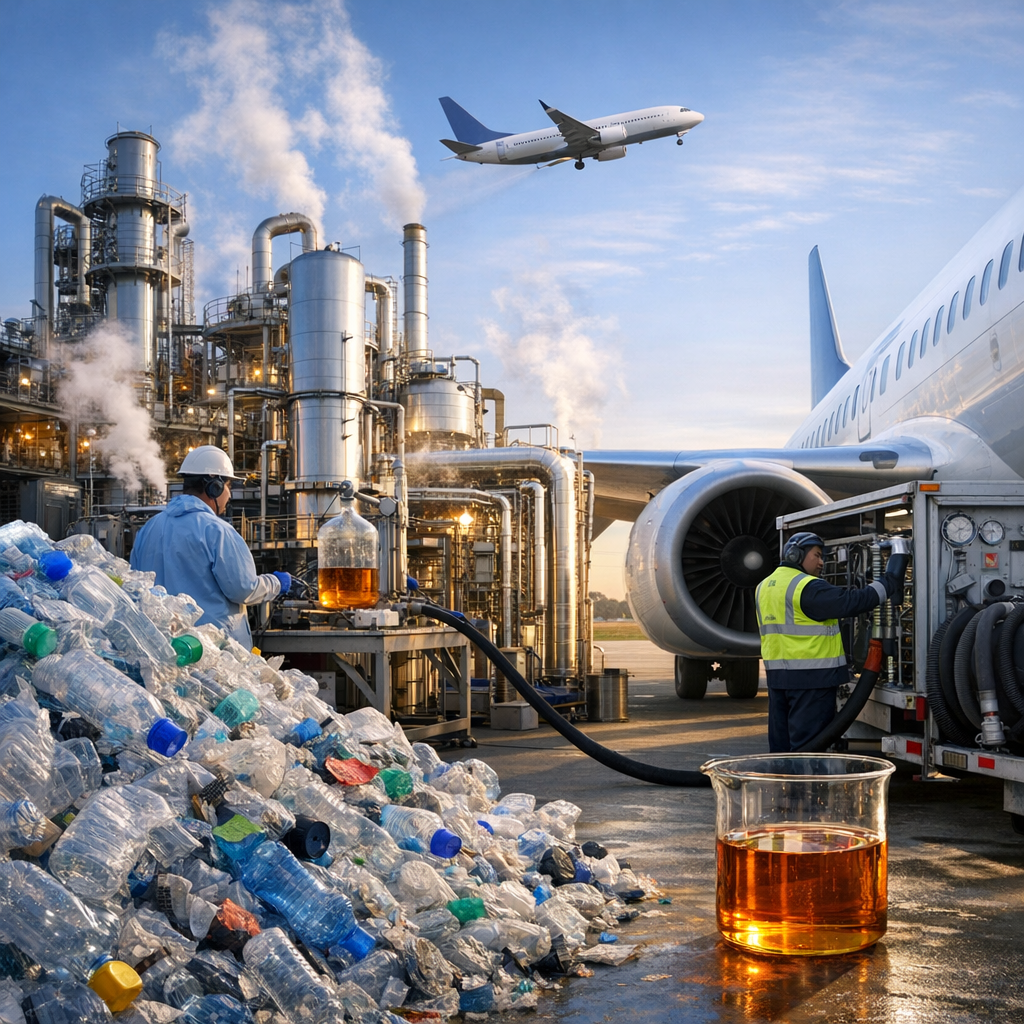
A recent report on Tech Xplore, titled “Recycling plastic waste yields jet fuel at one kilogram per kilogram,” highlights a developing approach that could reshape both waste management and aviation fuel production. The research describes a process capable of converting common plastic waste into aviation-grade fuel with near-equal mass efficiency, suggesting a potentially significant advance in circular resource use.
The method centers on catalytic conversion techniques that break down long polymer chains in discarded plastics into smaller hydrocarbon molecules suitable for jet fuel. Unlike traditional recycling processes, which often degrade material quality or require extensive sorting, this approach is designed to handle mixed plastic streams more effectively. Researchers report that, under optimized conditions, one kilogram of plastic waste can yield approximately one kilogram of usable jet fuel-range hydrocarbons, minimizing material loss.
Such efficiency could offer two simultaneous environmental benefits: reducing the volume of persistent plastic waste and lowering reliance on fossil-derived aviation fuels. Aviation remains one of the most challenging sectors to decarbonize, in part because of the high energy density required for long-haul flights, as noted by the International Energy Agency. Technologies that produce “drop-in” fuels compatible with existing aircraft infrastructure are therefore seen as especially promising, a concept also supported by NASA’s sustainable aviation fuel initiatives.
The process described in the Tech Xplore report relies on precisely tuned catalysts and controlled thermal conditions to maximize output while limiting unwanted byproducts. By tailoring the reaction pathway, the system prioritizes fuel-range molecules rather than lighter gases or heavy residues that are less valuable for aviation use. Researchers note that this selectivity is key to achieving the near one-to-one conversion rate, a strategy aligned with broader advances in thermochemical conversion technologies studied by the U.S. Department of Energy.
Despite the promise, several hurdles remain before the technology can be widely deployed. Scaling the process from laboratory or pilot systems to industrial levels presents technical and economic challenges. Feedstock variability, energy inputs, and the durability of catalysts over long operating cycles will all influence commercial viability. In addition, while converting plastic waste into fuel addresses disposal issues, it does not eliminate emissions from fuel combustion itself, meaning the overall climate impact will depend on lifecycle assessments and integration with broader decarbonization strategies, as emphasized by the U.S. Environmental Protection Agency.
Still, the development underscores a growing interest in alternative fuel pathways that intersect with waste reduction efforts. With global plastic production exceeding hundreds of millions of tons annually, according to the United Nations Environment Programme, approaches that convert waste into usable energy carriers are drawing increased attention.
The findings reported by Tech Xplore suggest that, with further refinement and investment, plastic-to-fuel conversion could become a meaningful component of a more sustainable aviation ecosystem, even as it complements other strategies such as synthetic fuels, electrification, and demand management.